Transversality as a strategy for the construction of projective thinking
DOI:
https://doi.org/10.5965/25944630622022e2151Keywords:
transdisciplinarity, Projective thinking, Design methodology, Project teachingAbstract
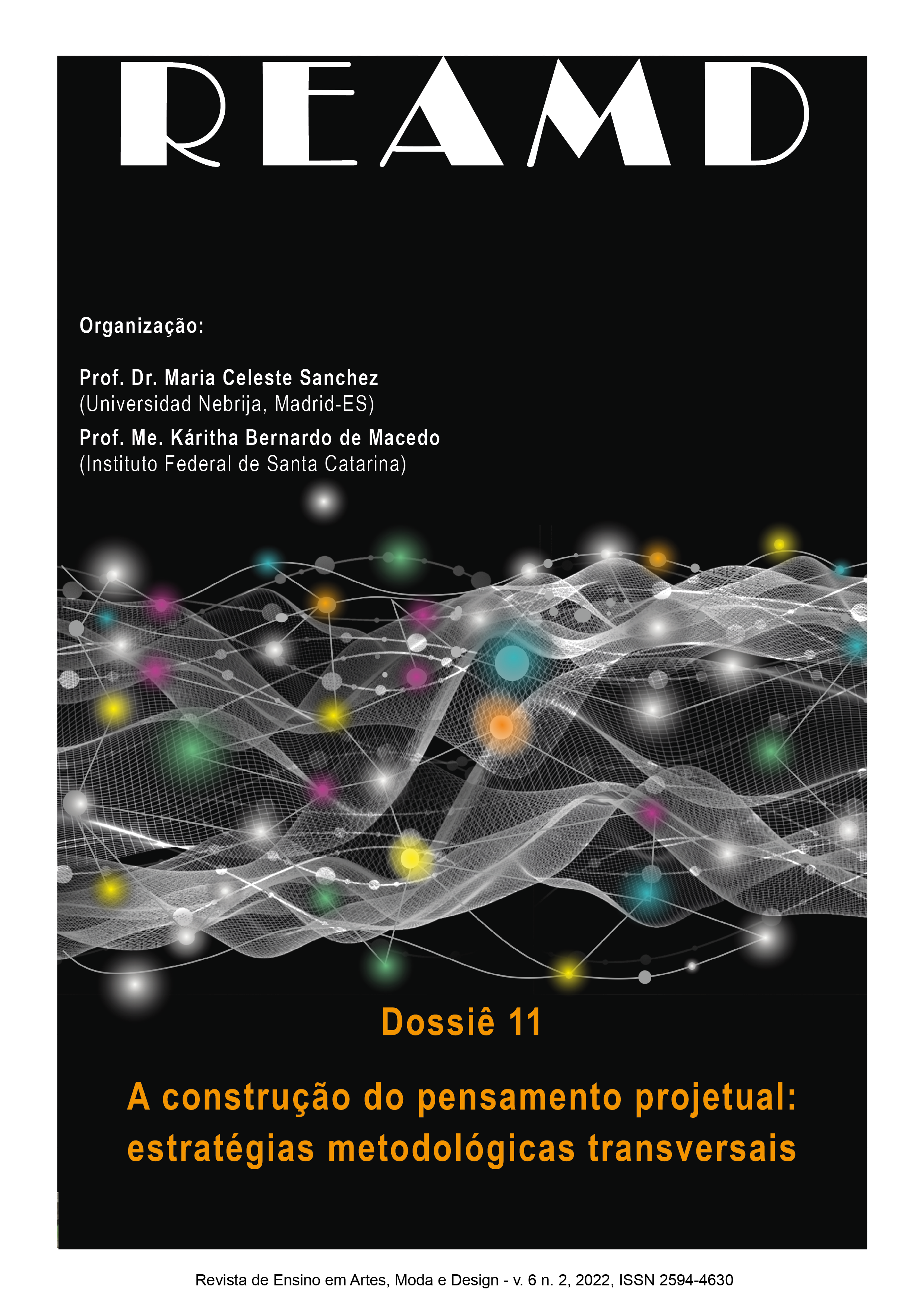
No âmbito educacional, quando tratamos do desenvolvimento do pensamento projetual, o grande desafio é gerar um entorno propício à transversalidade de saberes e ao aprendizado de meios que facilitem a gestão da criatividade. Nesse sentido, o dossiê número 11 apresenta o tema “A CONSTRUÇÃO DO PENSAMENTO PROJETUAL: ESTRATÉGIAS METODOLÓGICAS TRANSVERSAIS”, a partir de distintas reflexões sobre o instrumental metodológico utilizado na condução das práticas criativas em classe. Considerando o contexto multifacetado atual, cresce a demanda por abordagens pedagógicas interdisciplinares, que favoreçam a integração de saberes, a prática reflexiva e a atuação colaborativa entre alunos e professores. Diante disso, este dossiê oferece um espaço para compartilhar experiências e disseminar iniciativas aplicadas à gestão da criatividade em diferentes campos projetuais.
Downloads
References
COELHO, Luiz Antonio L. Por uma Metodologia de Ideias – In: COELHO, Luiz Antonio L. (Org.). Design Método. Rio de Janeiro: PUC Rio; Teresópolis: Novas Idéias, 2006. v. 1, Cap. 2, p.39 – 53.
COELHO, L. A. L. Percebendo o método. In: COUTO, R. M. (Org.). OLIVEIRA, A. J. (Org.). Formas do design: por uma metodologia interdisciplinar. Rio de Janeiro: 2AB, 1999. v. 1, Cap. 2, p.28 – 51.
SANCHES, M.C., BARBOSA, T.M., HERNANDIS, B. e MARTINS, S.M. Bases para o ensino/aprendizagem de projeto no design de moda: conectando diretrizes didáticas e estratégias metodológicas. Revista Moda Palavra, 2015, 9 (17), p. 119-144.
Downloads
Published
Issue
Section
License
Copyright (c) 2022 Káritha Bernardo de Macedo, Maria Celeste Sanches

This work is licensed under a Creative Commons Attribution 4.0 International License.
- Authors retain copyright and grant the journal the right of first publication, with work simultaneously licensed under the Creative Commons Attribution 4.0 International License, which allows for:
1. Share — copy and redistribute the material in any medium or format for any purpose, even commercially.
2. Adapt — remix, transform, and build upon the material for any purpose, even commercially.
The licensor cannot revoke these freedoms as long as you follow the license terms.Under the following terms:
1. Attribution — You must give appropriate credit, provide a link to the license, and indicate if changes were made. You may do so in any reasonable manner, but not in any way that suggests the licensor endorses you or your use.
2. No additional restrictions — You may not apply legal terms or technological measures that legally restrict others from doing anything the license permits. -
Plagiarism, in all its forms, constitutes unethical publication behavior and is unacceptable. This magazine uses iThenticate similarity control software.